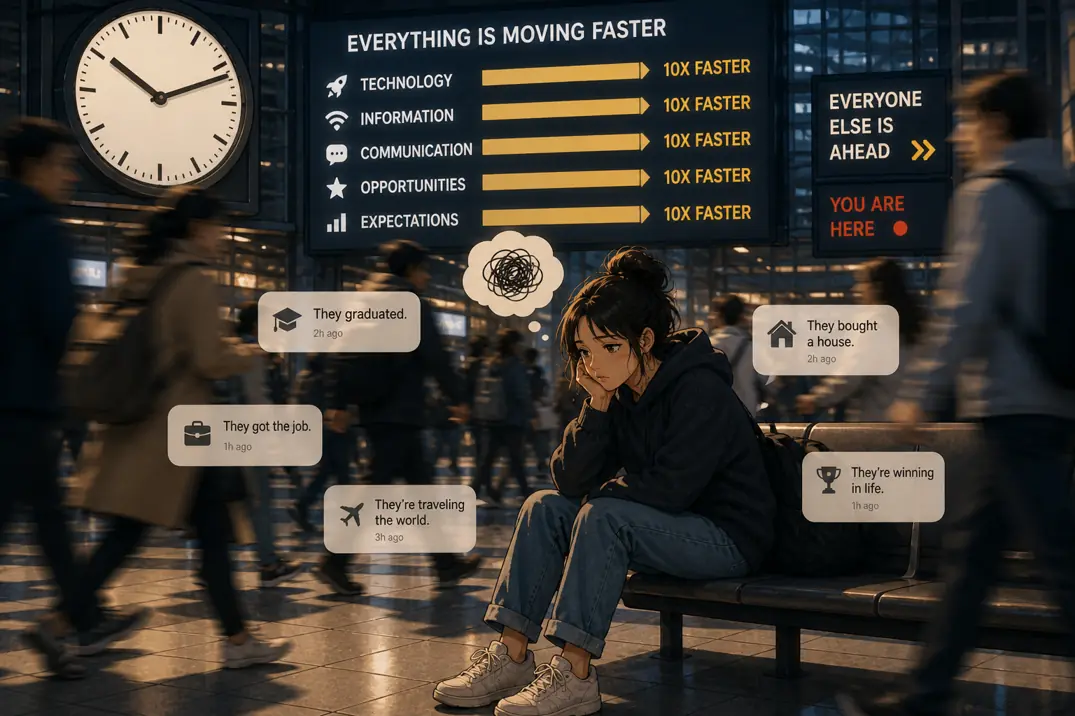
The smartphone buzzes with another notification. The email marked "urgent" arrives while you're still processing yesterday's tasks. Your colleague posts about their promotion on the same day you're struggling to finish a project that was supposed to be done last week. Everything is faster — but people feel like they're falling behind, trapped in a cycle where acceleration breeds anxiety rather than achievement. This isn't about individual failure or lack of effort. It's about measuring ourselves in a system that never stops moving, where the feeling of "not enough" grows silently even as we accomplish more than previous generations could have imagined.
Life Moves at an Unprecedented Speed
Modern life operates on a compressed timeline that previous generations wouldn't recognize. Email responses that once took days are expected within hours. Career milestones that used to unfold over decades now seem to happen in compressed cycles, with 25-year-olds launching startups and 30-year-olds feeling behind if they haven't achieved executive status. Dating apps turn relationship formation into rapid-fire decisions. Even leisure activities carry time pressure — streaming services release entire seasons at once, creating social pressure to binge-watch before spoilers emerge in conversations.
Technology Creates New Baselines for "Normal" Speed
The tools designed to make life easier have instead established new minimum speeds for daily functioning. Text messages receive read receipts, making delayed responses feel deliberately rude. GPS applications reroute drivers every few minutes to save thirty seconds. Food delivery apps promise meals within twenty minutes, turning a half-hour wait into a service failure. These conveniences don't create more time; they create higher expectations for how quickly everything should happen.
Success Becomes Impossible to Define
The markers that once indicated progress have become moving targets. Home ownership, long considered a milestone of financial stability, shifts further out of reach even for high earners in many cities. Career advancement no longer follows predictable paths, leaving people uncertain whether they're progressing appropriately or falling behind invisible benchmarks. Even personal achievements lose their satisfaction quickly — completing a marathon feels diminished when social media immediately suggests training for an ultramarathon.
Comparison Points Multiply Endlessly
Traditional communities provided limited reference points for measuring success. People compared themselves to neighbors, classmates, or family members whose circumstances they understood. Now, social media creates exposure to thousands of curated success stories from strangers whose full contexts remain invisible. The software engineer in Ohio sees the vacation photos of a consultant in Singapore, the startup founder in Austin, the freelance designer in Portland — each representing a different version of professional achievement that seems simultaneously attainable and impossibly distant.
Social Media Amplifies the Perception of Others' Progress
Instagram stories show colleagues attending conferences while you sit in traffic. LinkedIn updates announce promotions, new positions, and professional achievements in a constant stream. These platforms compress others' career highlights into a daily feed, creating the impression that everyone else is advancing rapidly while your own progress feels incremental. The selective nature of social sharing means you see others' victories without their struggles, their celebrations without their setbacks.
Achievement Becomes Performance
Real accomplishments now require social documentation to feel fully realized. The promotion doesn't feel complete without the LinkedIn announcement. The vacation lacks satisfaction without the Instagram posts. The new skill needs to be broadcast to professional networks. This performative aspect of achievement adds another layer of pressure — not only must people accomplish goals, but they must also present them effectively to their networks, turning every success into a content creation challenge.
Goals Shift Before They Can Be Reached
The concept of "enough" has become obsolete in a culture of continuous optimization. Reaching a target income leads immediately to the next income bracket as the goal. Achieving work-life balance gets redefined as work-life integration, then work-life harmony, then something else entirely. Personal development, once focused on mastering specific skills, now emphasizes continuous learning and adaptation. The finish line keeps moving, making completion impossible and rest feel like stagnation.
Milestones Lose Their Meaning
Life stages that once provided clear transition points have become fluid and ambiguous. Graduate school extends into the late twenties or early thirties. Marriage happens at various life stages or not at all. Career changes occur multiple times, eliminating the concept of a single professional identity. Without clear milestones, people lose reference points for measuring their progress, leading to a persistent sense of incompletion regardless of actual achievements.
The Bar for Productivity Keeps Rising
What counts as a full day's work has expanded beyond recognition. Answering emails outside business hours has become standard in many industries. Side hustles are presented as necessary supplements to primary careers. Personal productivity requires optimization through apps, systems, and life hacks. The baseline expectation is no longer completing assigned tasks but continuously improving efficiency, output, and skill sets. Doing your job well is insufficient; you must also be growing, networking, and preparing for future opportunities.
Rest Becomes Another Task to Optimize
Even downtime carries performance pressure. Sleep requires tracking through devices and apps. Exercise must be measured, recorded, and integrated into social fitness platforms. Meditation becomes a daily practice with streaks to maintain. Hobbies need to show progression and improvement. The concept of unproductive time has become almost foreign, replaced by the idea that every moment should contribute to personal optimization or professional development.
Feeling Behind Has Become the Default State
Most people experience a persistent sense of inadequacy despite objective success. They earn more than their parents but feel financially insecure. They have access to more opportunities but feel overwhelmed by choices. They accomplish more tasks but feel less productive. This isn't personal failure — it's the natural result of measuring progress against constantly accelerating standards.
The truth is that people are not actually behind. They are simply trying to find their footing in a system designed to create perpetual motion rather than sustainable progress. Recognition of this reality doesn't solve the problem, but it offers a different perspective: the feeling of falling behind may be less about individual inadequacy and more about the impossibility of keeping pace with a world that has confused speed with direction.